Anxiety is one of the most, if not the most popular issue that people come to see me for therapy. It is also a subject I have personal experience of.
Anxiety is Normal…
Anxiety is, believe it or not, perfectly normal. It is how our bodies have kept us alive for thousands of years and so far it’s worked rather effectively. Unfortunately some of us feel anxiety in situations where we should not. We have evolved emotionally, cognitively, we’ve built governments and space ships, but our bodies still react to anything we view as stressful or that makes us feel vulnerable in exactly the same way physically as we did as cave people. This can be where anxiety starts to cause us problems and can make life an incredibly horrible experience. How do I know this? Other than my professional training I had some pretty tough life training that got me interested in anxiety issues and therapy, mainly due to the fact that for years I suffered with Generalised Anxiety Disorder.
I Know How You Feel….Genuinely
It is my personal belief that everyone on this planet has their own personal hell. Generalised Anxiety Disorder (GAD) was mine. When a client steps into my private practise and tells me all about the anxiety they feel and I reply with “I know exactly how you feel” – I genuinely mean what I’m saying, it’s not just for effect.
I suffered in silence for years before I finally got help. Because I didn’t understand that anxiety is emotional and cognitive I thought there was something physically wrong with me, or that as soon as I hit that target / moved house / got through Christmas / got through New Years / got through my birthday etc I’d be OK.
I wasn’t OK.
Finally I went to my doctor because my headache was so bad I thought I must have a brain tumour and I had to face reality. My doctor informed me I had tension headache, it’s a common anxiety symptom, and as I broke down in her office she told me to get help. I spent the next few months Googling therapists until one day I had a series of 5 panic attacks with some of the worst symptoms I’d experienced yet and enough was enough. I made the call and haven’t looked back since.
What are the Symptoms of Anxiety?
So far I am yet to come across an anxiety symptom, be it physical, emotional or cognitive, that I have not experienced at least on some level myself. So for those that are unsure what anxiety is, or perhaps you think you may be suffering from it but are unsure, here’s a run-down of a few symptoms. I’ve had all of these so although I’m writing from a personal perspective, please note that every single client I’ve ever treated with anxiety has had one, more, or all of these symptoms on a regular basis:
- Butterflies – in your stomach. Sometimes this is described to me as “somersaults”. Please note there’s a difference between where your stomach is (under your rib cage) and where your bowels are (under your stomach).
- IBS – I’ve had many a description of how this feels in an anxiety situation, from feeling like their tummy has “dropped”, to having to run the loo, to being in excruciating pain, to being constipated.
- Needing to pee
- Nausea – this often accompanies the butterflies but can appear on its own
- Tight chest / chest pain – if caused by anxiety this is due to the muscles in your chest tensing up.
- Aches and pains – in your head, neck, back, shoulders. I used to get tension headache in the form of what felt like small explosions in the back of my head. It was caused by my neck muscles tensing.
- Sweating – sometimes accompanied by feeling hot. I used to suffer from a “furnace” like effect where I’d feel like my neck and head were on fire. It was very weird!
- Irregular breathing – sometimes this happens just before an anxiety or a panic attack.
- Heart Palpitations – this is basically an awareness of your own heartbeat but the heart can appear to beat faster too.
- Odd feelings in limbs – I’m not sure how to put this so I’ll give examples of how this has been described to me. Personally I felt like my arms and legs were “tingling”. Others have described the feeling of “jelly legs” or that they lack proper control over their limbs, some people say they feel like they’re “walking on air” or their limbs feel “hollow”.
- Dry mouth
- Jumpy – this is the inability to be still or calm or the tiniest thing makes you jump out of your skin.
- Insomnia – this covers not only the inability to get to sleep but also waking up in the night, perhaps following bad dreams, and not being able to settle again.
- Dizziness – sometimes this feels like “the world shifts”, sometimes it’s full on vertigo like dizziness. A very popular cognitive symptom I come across is the crippling fear of being dizzy, where the person constantly asks themselves if they feel dizzy. This is a manifestation of a fear of losing control and usually happens once the person has experienced a panic or anxiety attack with dizziness involved.
- Sharpness – this is where everything seems brighter, sounds are louder, you can even feel the slightest breeze on your skin. It can get to a point where you feel your senses are “overloaded”. The entire point of anxiety is to keep you alive, the adrenaline released makes you feel sharper so you can easier see, hear etc the danger your brain thinks it’s detected.
- Fear – if you feel afraid and you don’t know why, or you feel afraid more often than not.
There are lots and lots more symptoms, sometimes they seem to have aspects of each other. Some people have a habit of worrying so much they feel anxious. Others over think. There are some people so afraid of the fear they become fearful. Hypnotherapy can be extremely helpful with anxiety issues, even just from the point of view of learning how to relax and allowing yourself to let go into trance.
If you are suffering from anxiety, or think that you might be, please read this carefully and know this comes from someone who genuinely knows exactly how you’re feeling.
You are not alone.
You are not a freak.
Your next anxiety or panic attack is designed to keep you alive not to kill you.
There are coping techniques out there that can help you not only to manage your anxiety but to help you overcome it.
Ignoring it will not make it go away.
All of those random and irrational thoughts you’re having are just that; random and irrational.
You do not need to believe everything your anxiety tells you.
Those negative thoughts you’re telling yourself probably aren’t true and they certainly aren’t helpful.
The panic attack will pass. You always come through it, right? Exactly. Even if the anxiety levels go down to a certain level but never go away, they still go down.
Fighting the anxiety is not a remedy, accepting it is an issue and getting help, in whatever form, helps more than you can ever imagine.
If you want to get better, that’s your decision, you have more power in this situation than you think. It will take time but you don’t have to feel like this forever.
Anxiety on a Spectrum
The spectrum of anxiety includes mild / generalised (“free-floating”) anxiety, anxiety attacks through to severe phobic reactions. There are various causes of anxiety: Severe stress, a series of negative experiences building up to severe anxiety, fear of fear (you could have a fear you will panic in a certain situation). You can learn to feel anxious in certain situations from someone else, eg: a parent being openly anxious about getting rid of a spider could pass this anxiety onto their children.
Anxiety is a manifestation of an underlying issue and the best way to get rid of the anxiety is firstly to learn some coping mechanisms and importantly to deal with the underlying disturbance. Anxiety can have it’s roots in a traumatic event , for example from childhood, but a client may or may not be aware of this event or be able to recall it. A severe past trauma can also cause a phobia.
Some people are more susceptible to anxiety than others. Over time the subconscious can start linking other situations that are similar to the one that causes anxiety. This can cause people to experience anxiety and not know the cause. Eg:, a driver that is involved in an accident may then feel anxious when they start driving again. This is the subconscious linking the physical symptoms of the crash with the action of driving. This means that anxiety is an avoidance mechanism used by the subconscious to ensure you avoid dangerous situations.
I work for private medical companies and insurance companies. Often times the client they ask me to treat has been in a car accident. As a result they feel anxious. Sometimes it’s a specific fear (like crossing the road if they were knocked down) and sometimes it’s a general anxiety. When someone is feeling vulnerable as a result of the accident, sometimes they can’t shake the feeling of being “in danger”.
The Anxiety Cycle
Because of the feelings it creates, anxiety is a cyclical process, see below:
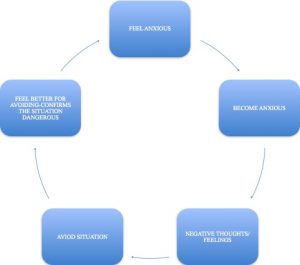
Because of this cyclical process, anxiety can be a pre-curser to depression. When someone feels anxiety all the time this is called General Anxiety Disorder. It can be a debilitating condition leading to other symptoms such as panic attacks.
A panic attack is out of control anxiety and can come on for no apparent reason. They can be triggered by your subconscious recognising and linking a situation to something it sees as threatening. This can be from a learned experience and panic attacks are typically characterised by several symptoms (as mentioned earlier). Panic attacks can last from 5 minutes to 2 hours, but however long it feels like a lifetime. Panic attacks can be a common symptom when dealing with phobias. If your subconscious wanted to tell you something was an extreme danger, a very good way to do this is to make you panic so you run away from the situation or fight it off.
Different Types of Anxiety
There are lots of different types of anxiety like there are lots of different types of phobia. You technically could be anxious or phobic about anything! Some of the common anxieties I see in practice are here:
- Generalised Anxiety Disorder, characterised by a feeling of anxiety all the time
- Social Anxiety, characterised by a general anxiety around people or fear of people
- Panic Disorder, characterised by recurring panic attacks causing a series of intense episodes of extreme anxiety during panic attacks. It may also include significant behavioural changes because of ongoing worry about having other attacks. The latter are called anticipatory attacks.
What To Do Now….
If you would like help, I’m here to provide that for you. I provide a warm, positive and confidential atmosphere in order for you to tell me how you feel. We can then work together to help you feel more in control as soon as possible.
I aim to get my clients to a stage where their anxiety doesn’t bother them anymore. A stage where the emotional and physical stress is a thing of the past. You deserve to move on with your life. Contact me today if you would like to discuss your needs further, I’m happy to have a chat with you! Call: 0330 100 5163 email info@cloud9-therapy.co.uk
